

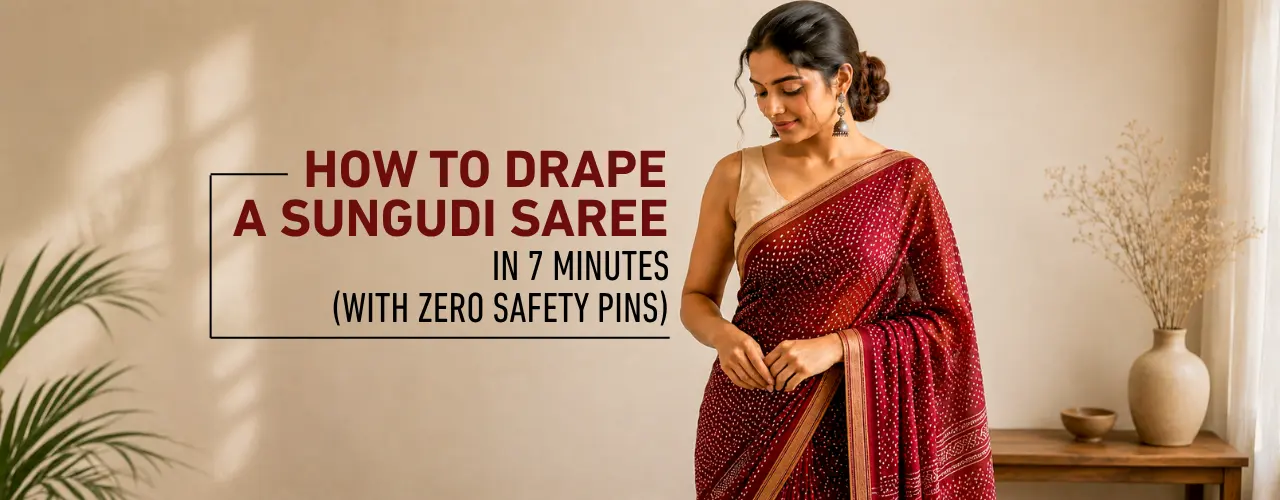
The fear of safety pins is real. For many women — especially those new to sarees, or returning to them after years away — the multiple pins involved in a traditional drape feel like the final barrier between them and this beautiful garment.
Here is the truth: a Sungudi sarees, specifically, is one of the most forgiving fabrics to drape without pins. Its cotton weave has a natural grip. It does not slide, slither, or shift the way chiffon or georgette does. The fabric essentially cooperates with you.
The seven-minute, zero-pin method below is built for daily use — whether you are dressing for office at 8 AM, a temple visit at noon, or a family function in the evening. Follow these steps once and the muscle memory builds faster than you expect.
What You Need Before You Start
- Your Sungudi saree (5.5m to 6.2m length is ideal for most heights)
- A well-fitted petticoat in a matching or complementary colour — this is your foundation. A loose or slipping petticoat is the most common cause of a drooping drape, not the saree.
- A matching blouse, fully fastened before you begin draping
- A waistband or thick drawstring on your petticoat — this is where the saree is tucked and it must hold firmly
Note on safety pins: once you have practised this method three to four times, you will discover that the Sungudi’s cotton grip makes pins genuinely unnecessary for most occasions. However, keep two pins available as backup for the first few attempts.
The Seven-Minute Drape: Step by Step
Minute 1 — The First Tuck
Hold the saree with the plain edge (the end without the border) at your navel. Tuck approximately 10–12 inches of fabric into your petticoat waistband at the centre front, going from right to left across your waist.
This initial tuck should be firm — press the fabric down into the waistband rather than just folding it over the top. This anchor tuck is what holds the entire drape, so spend 20 extra seconds getting it secure.
The saree should now be hanging down on your left side, with the border falling along the bottom edge.
Minute 2 — First Wrap Around the Body
Take the saree and wrap it once around your body from right to left, keeping the bottom border at a consistent height — approximately 1 inch from the floor when you are standing straight. Do not let the border dip or rise as you wrap.
As you complete the wrap and return to the front, the border should be running cleanly along the hem of your petticoat. Tuck any excess into the waistband at the front to hold this wrap in position.
Minute 3 — Making the Pleats
This is the step most beginners find challenging, but the Sungudi’s cotton fabric makes it easier than silk or synthetic sarees because the pleats hold their shape without slipping.
Take the remaining length of saree and create pleats by folding the fabric back and forth like a hand-held fan. Each pleat should be approximately 5 inches wide. You need between 5 and 7 pleats depending on your waist size.
Here is the key: make the pleats with both hands simultaneously. Place the fingers of your left hand as the guide point and fold the fabric over them with your right hand. This creates uniform pleats quickly without counting.
Gather all the pleats together in your left hand and hold them as a bundle.
Minute 4 — Tucking the Pleats
Hold the pleats so they face slightly to the left (toward your left hip). Tuck the gathered pleat bundle firmly into your waistband at the centre-front, slightly left of your navel.
Fan the pleats open slightly after tucking so they fall in a clean cascade rather than bunching. The pleats should open downward and to the left, creating the characteristic sweep of the drape.
At this point, with a Sungudi saree, these tucked pleats will hold reasonably well without a pin. The cotton texture catches against the petticoat fabric. If you feel uncertain during your first attempts, place one small pin through the pleat bundle into the petticoat waistband.
Minute 5 — Preparing the Pallu
You should now have the remaining length of the saree — the pallu — hanging from your right side. This is the decorated end of the saree, where the full border and the pallu design appear.
Hold the pallu and drape it across your body from right to left, bringing it across your stomach and up over your left shoulder from front to back.
Spread the pallu across your shoulder so the full border is visible. The pallu should reach to approximately mid-back when hanging behind you — adjust how much you bring over the shoulder to achieve this.
Minute 6 — Securing the Pallu
This is where most zero-pin methods succeed or fail, and where the Sungudi’s cotton fabric gives you a genuine advantage.
After placing the pallu over your left shoulder, tuck approximately 3 inches of the pallu into the back of your blouse at the shoulder seam. Cotton-to-cotton grip is strong enough to hold this in most cases.
Alternatively — and this works particularly well for daily office wear — pleat the pallu neatly before draping it over the shoulder. A neatly pleated pallu holds its structure far better than an open one and requires no pinning for most of the day.
If you prefer to keep the pallu pinned for absolute security: use a single pin at the shoulder of your blouse, pinning the pallu to the blouse sleeve or shoulder seam. One pin at the shoulder is all a Sungudi saree ever needs.
Minute 7 — Final Adjustments
Stand in front of a full-length mirror. Check:
- The bottom border is consistent — at the same height all the way around (approximately 1 inch from the floor)
- The pleats are fanning cleanly and not bunching
- The pallu is lying flat on the shoulder with the border visible
- The waist tuck is smooth — no bunching or doubling of fabric at the front
If the border dips at the back, the issue is in the first body wrap — unwrap and redo at a slightly higher level. If the pleats bunch, shake them gently while holding the waistband tuck in place and re-fan them.
You are done. Seven minutes.
Why Sungudi Cotton is the Best Fabric to Learn Draping On
- The open weave creates natural friction against petticoat fabric, holding tucks without pins.
- The fabric is forgiving — if a pleat goes wrong, it is easy to re-drape without starting over.
- The lightweight nature means you can feel how the fabric is sitting without it pulling away from your adjustments.
- Cotton does not slip on itself the way silk or chiffon does — each layer grips the previous one lightly.
If you have struggled with other saree fabrics, try draping a Sungudi first. Most women who learn on Sungudi cotton transition to other fabrics with greater confidence.
Common Mistakes and How to Fix Them
Uneven border height: Usually caused by the initial first wrap being inconsistent. Start fresh from the first body wrap, holding the border at a fixed height throughout.
Pleats that won’t stay: Check your petticoat — if it is loose or the waistband has stretched, the tucks have nothing to grip. Tighten the drawstring fully before draping.
Pallu slipping off the shoulder: Pleat the pallu before placing it over the shoulder. Pleated pallus maintain shape significantly better than open ones.
Too much fabric leftover at the end: Redistribute by taking wider pleats (6–7 inches each) to use more fabric in the pleat section.
Frequently Asked Questions
Q1. Is this draping method suitable for very tall or very petite women?
Yes, with minor adjustments. Petite women (under 5’2″) should use a saree no longer than 5.5m to avoid excess fabric, and reduce pleat width to 4 inches to create neater, smaller pleats. Taller women (over 5’7″) may need a 6m or 6.2m saree and wider pleats (6 inches) to maintain proportion.
Q2. How do I keep the drape looking neat during a full working day?
The two key points that slip during the day are the pleat tuck and the pallu. For the pleats, a single pin through the bundle into the petticoat waistband is enough. For the pallu, tucking it into the blouse at the shoulder seam holds it through most daily activities. If your work involves physical movement, one shoulder pin is advisable.
Q3. Can I drape a Sungudi saree without a petticoat?
Technically possible but not recommended. The petticoat provides the foundation grip for all your tucks. Without it, every section of the drape becomes insecure. A well-fitted petticoat is the most important investment in comfortable saree draping.
Q4. My Sungudi saree has a heavy zari border — does the draping method change?
The method remains the same, but give extra attention to the border height during the first body wrap. A heavy zari border tends to pull the hem down slightly — compensate by starting the wrap half an inch higher than you think you need.
Q5. How long does it take to get genuinely fast at draping?
Most women reach a comfortable 10-minute drape after three to five practice sessions. The seven-minute benchmark is achievable within two weeks of daily wearing. Practice on a Saturday morning before you need to be anywhere, and the pressure-free environment makes the muscle memory build faster.
Q6. Are Sungudi sarees good for first-time saree wearers learning to drape?
They are arguably the best fabric for beginners. The cotton weight is manageable, the fabric grips itself and the petticoat, and mistakes are easy to correct. If you are new to sarees and want to learn, start with a plain or simple-bordered Sungudi cotton from sungudi.com — it will teach you faster than any other fabric.
Shop Authentic Sungudi Sarees at sungudi.com
Browse our full collection of handcrafted Madurai Sungudi sarees at sungudi.com. Have a question? WhatsApp us at +91 99940 25159 — we’re happy to help you find the perfect saree for any occasion.