
If you’ve searched for the “best place to buy sungudi sarees online,” you’ve probably already noticed the problem: dozens of listings, wildly different prices for what looks like the same saree, and no easy way to tell an authentic handloom piece from a printed imitation until it lands on your doorstep.
This guide walks you through what actually makes a sungudi saree genuine, what to check before you buy from any seller, and where the real value lies so you can shop with confidence, whether it’s your first sungudi or your fifteenth.
What Makes a Sungudi Saree Authentic?
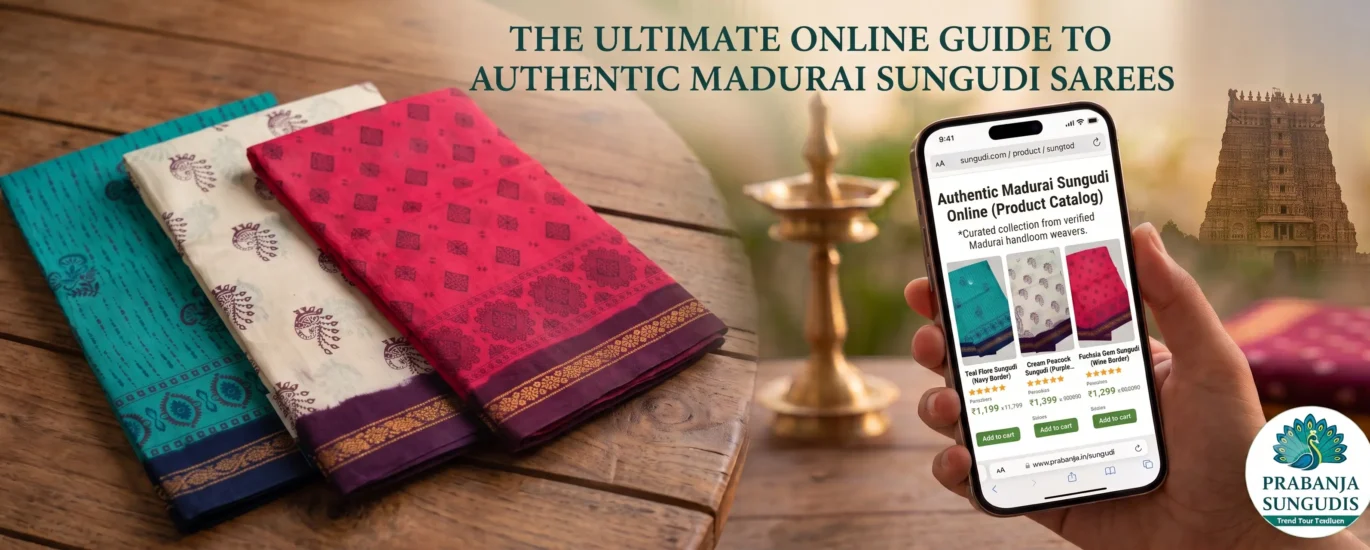
Sungudi sarees originate from Madurai, Tamil Nadu, and are traditionally known for their fine cotton weave and distinctive tie-dye dot patterns. But “Sungudi” has become a popular enough term that plenty of printed cotton sarees now borrow the name without the technique behind it.
The Traditional Tie-Dye (Bindi) Technique
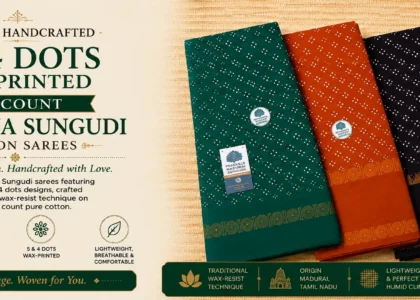
Authentic sungudi sarees get their signature dotted pattern from a hand tie-dye process — tiny sections of fabric are pinched and tied before dyeing, creating small untouched circles once the thread is removed. Done by hand, no two motifs are perfectly identical, and you’ll often see slight variation in dot size and spacing across the fabric. This is a feature, not a flaw — it’s the fingerprint of a handmade process.
Cotton Quality and Weight — What to Check
Genuine sungudi cotton has a soft, slightly textured hand-feel and a breathable weight suited to Tamil Nadu’s climate. Cheaper imitations often use a stiffer, more uniform cotton blend that feels papery rather than soft, especially after the first wash.
Common Fakes: Printed vs. Handloom Sungudi
The biggest giveaway is pattern uniformity. If every dot on the saree is identical in size and perfectly spaced in a repeating grid, it’s almost certainly machine-printed rather than hand tie-dyed. Printed versions are not inherently bad — they’re often more affordable — but they should be priced and marketed as such, not passed off as handloom.
What to Look for When Buying Sungudi Sarees Online?
Once you know what authentic sungudi looks like, the next challenge is finding a seller you can trust without physically handling the fabric first.
Seller Transparency (Origin, Weaver Info, Certifications)
Look for sellers who are specific about where the saree is woven and dyed. Vague listings that just say “traditional saree” with no mention of Madurai, weaver source, or fabric composition are a yellow flag. Brands that share their weaver partnerships or sourcing story tend to be more accountable for what they’re selling.
Return Policy and Buyer Protection
Since you can’t feel the fabric before buying, a clear, genuinely usable return policy matters more here than almost any other product category. Check the return window, who pays return shipping, and whether the policy explicitly covers “not as described” cases — not just damaged-in-transit ones.
Real Customer Photos vs. Studio-Only Images
Studio photography under perfect lighting can make almost any cotton look premium. Before buying, look for real customer photos or video — draped, in daylight, ideally showing the fabric’s texture up close. If a listing has hundreds of reviews but zero customer photos, that’s worth noticing.
Top Places to Buy Sungudi Sarees Online
Dedicated Heritage Brands
Brands built specifically around sungudi and Madurai handloom sarees — rather than general saree retailers — tend to have deeper sourcing relationships and more specific product knowledge. This usually shows up in more detailed product descriptions (weave type, dye process, cotton count) rather than generic saree copy reused across hundreds of SKUs.
General Marketplaces (Amazon, Flipkart, Meesho)
Marketplaces offer convenience, wide selection, and easy returns, but product quality varies enormously between third-party sellers on the same platform. It’s common to find both genuine handloom sungudi and printed imitations listed side by side under near-identical titles. If you buy here, lean heavily on seller ratings, photo reviews, and return policy rather than the product title alone.
Local Madurai Weaver Cooperatives (Offline-to-Online)
Some weaver cooperatives and local Madurai retailers have started selling online directly or through social media. These can offer strong authenticity and fair pricing to the weaver, though the online shopping experience (site design, checkout, delivery tracking) is sometimes less polished than a dedicated ecommerce brand.
Price Guide — What Should You Actually Pay?
Pricing is one of the most confusing parts of buying sungudi online, because “Sungudi” covers a wide quality range.
- Entry-level cotton Sungudi: roughly ₹500–₹1,200. These are typically lighter cotton, simpler tie-dye patterns or partial printed elements, and a plain or narrow border. Good for everyday wear.
- Premium handloom or zari-border Sungudi: roughly ₹1,500–₹3,000 and above. These feature finer hand tie-dye work, heavier authentic cotton, and zari (metallic thread) borders suited for festive or gifting occasions.
If a saree is priced well below ₹500 but marketed as “handloom” or “authentic Madurai sungudi,” treat that as a signal to look closer at the fabric description and reviews before buying.
How to Care for Your Sungudi Saree
Washing and Drying Tips
Hand wash in cold water with a mild detergent, especially for the first few washes, to protect the tie-dye colors. Avoid wringing — gently press out excess water instead — and dry in shade rather than direct sunlight to prevent color fading.
Storage to Preserve the Tie-Dye Pattern
Store folded in breathable cotton cloth rather than plastic, and refold along different lines every few months to avoid permanent crease lines forming across the dyed pattern.
Why Shop Sungudi Sarees at Prabanja
Our Weaver Partnerships
At Prabanja, our sourcing runs directly through Madurai’s handloom weaving community, keeping the traditional tie-dye technique and cotton quality consistent across our Kolam Design, Checked Zari, and Plain Sungudi collections.
Shipping, COD, and Return Policy
We offer cash on delivery, straightforward returns, and clear product descriptions so you know exactly what you’re getting before it ships — no surprises when the package arrives.
Browse our Kolam Design Sungudi collection for intricately patterned everyday wear, our Checked Zari border sarees for a festive look, or our Plain Sungudi sarees for simple, versatile options. For care and background, see our full guide to Tamil Nadu’s saree traditions.
Frequently Asked Questions
What is a Sungudi saree?
A Sungudi saree is a traditional cotton saree from Madurai, Tamil Nadu, known for its hand tie-dye dotted pattern created through a resist-dyeing technique.
How can I tell if a Sungudi saree is authentic handloom cotton?
Look for slight irregularity in the dot pattern (a sign of hand-tying), a soft cotton feel, and a seller who’s specific about weaving origin and process, rather than generic “traditional saree” descriptions.
What is the price range for a genuine Sungudi saree?
Entry-level cotton sungudi typically ranges from ₹500–₹1,200, while premium handloom pieces with zari borders can run ₹1,500–₹3,000 or more.
Is it safe to buy Sungudi sarees online?
Yes, as long as you check the seller’s return policy, look for real customer photos, and verify fabric and origin details in the product description before purchasing.
How do I care for a Sungudi saree at home?
Hand wash in cold water with mild detergent, avoid wringing, dry in shade, and store folded in breathable cloth rather than plastic to preserve the color and pattern.